Three Controversial Truths To Save NA Esports. Here is Number 1.
Truth #1 - Gaming is global. Esports is local. Pro Teams should be local as well.

Professional esports teams aspire to be global brands. But in order to conquer the world you must first conquer a country. And before you conquer a country you must first conquer a city. When armies overexpand they collapse. Your base (i.e. one specific city or region) must be selected and fortified so your brand becomes dominant and ubiquitous there.
All that sounds like common sense for a brick and mortar company or traditional sports team, but isn’t gaming different since it is digital and scalable? Aren’t esports brands ‘beyond geography’? Nope, quite the opposite.
Without geography you are constantly re-aquiring the same global audience against every competitor at once.
Fandom and Identity
For your esports team, the best way to become a global brand is to intentionally choose a home city or region from which to build the heat of that global fandom. We know from traditional sports that this is the case -- whether it was the Chicago Bulls in the time of global superstar Michael Jordan or Real Madrid today. Real Madrid is a club with a clearly defined home city identity, tradition, physical stadium and local bars for watch parties, plus massive global fandom via live media and digital and social media. All sports operate this way.
One of the challenges facing esports is growing a more mainstream audience and regionalization helps this. For anyone who claims esports is beyond tribal geography just attend a live event and watch what happens when your favorite pro team is eliminated. The fans from NA now cheer for the other NA team; the fans from the EU cheer for the other EU team, and China for China and Korea for Korea and so on.
I do not follow baseball but when the Atlanta Braves are winning, I jump on that bandwagon. As I will with the Hawks, the Falcons, the Dream, and so on. City based fandom cultivates generational fans (“in this house we cheer for the Steelers”) and the opportunity for this exists in esports, but not without a home region. Even when teams are bad, with a geographic base they retain baseline support
Geographic identity acts as a pre-installed loyalty system.
Market Segmentation
A team needs other teams to play of course. The Atlanta Hawks need the Dallas Mavericks and even the New York Knicks (as painful as that specific example is right now). Teams should compete on the field of play but cooperate to grow the overall ecosystem.
Home region systems divide the world into manageable competitive units: Atlanta market, LA market, Seoul market, London market, etc.
Each becomes a semi-protected zone for: sponsorship activation, fan development, local storytelling, community building, local player development, and more.
This creates a divide-and-conquer structure and without it growth is linear, expensive, and undifferentiated.
Sponsorship value is structurally weaker without geography
Pro teams are expanding and diversifying their revenue streams, but brand sponsorships remain very important. Teams have many challenges delivering ROI on sponsorships and lack of regionalization is one of the biggest factors.
Sponsors don’t just buy impressions.
Sponsors buy localized relevance and community presence.
A home-city team can boast “We own gaming culture in Dallas”, while a global team says “We reach global gamers”.
The reality is there are few true global brands that would sponsor your team. The few global corporate brands still have localized campaigns and geographically based marketing initiatives and budgets and decision makers. And those global brands are simply much more likely to partner with a Publisher (e.g. Riot) or League/Event Operator (e.g. EFG, Blast, Skillshot) for true global audience vs. a single team.
For a Pro Team, an ill-defined geographically distributed large audience is worse than a smaller well defined regional audience. Because with a regional audience, and specific demographics information, you can match against brand sponsors appropriately and deliver ROI.
To not pick on any specific team, I’ll give a specific example of common audience mismatch that is a league from long ago. Way back in 2016 our friends down the road at Turner Broadcast announced ELEAGUE, a professional CS:GO broadcast on both TBS and livestream platforms. It was by the way a very excellent product, with strong competition and commentator talent and venue and production. So everyone was excited when multiple mainstream sponsors hopped on board, including Arby’s who delivered an awesome campaign that included iconic, meme-heavy and CSGo themed creative & commercials
The problem in delivering sponsor ROI was that the CSGo audience is in fact ginormous. But also very global. While Arby’s is very not global.
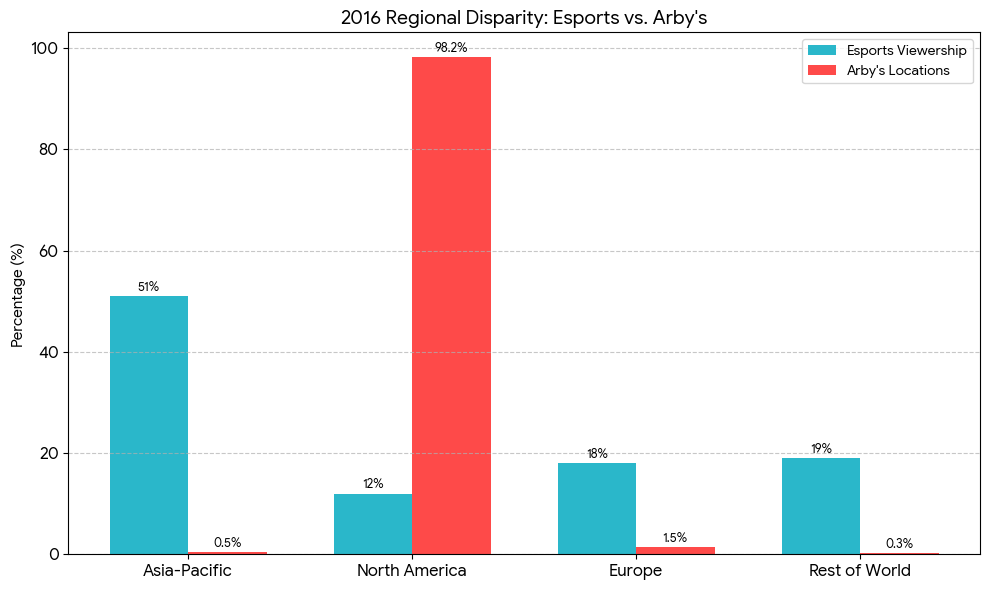
What if your esports organization had a well defined geographic audience? Think of the efficiency of the sales cycle. Think of the greatly improved ability to deliver ROI in creative ways in your backyard!
But, what about the city-based Overwatch League That Failed?
Excellent question! My claim and recommendation is around fandom building and market focus and activation, NOT that competition has to be played in the home cities itself at this stage of esports. Like most esports the Overwatch League approach, with home and away games that migrated to homestands, was simply way too expensive as an operating model. Whether games are played online or in a central studio or travelling events does not take away from the importance of teams building fandom with geographic binding.
As examples one can look at
Formula 1 - where drive teams are based in cities but the races are neutral-sites as a global touring event. That said, Ferrari = Maranello / Italy.
UFC - where fighters represent countries/cities but events are global touring shows
Teams should not abandon geography - even if it is decoupled from competitive logistics it should be preserved as identity architecture.
Why “global teams” initially looked correct
To be fair, global esports teams made a lot of sense at the time.
Three assumptions drove the model:
Esports is digital-first (so geography doesn’t matter)
Global reach = large audience
Esports brands could scale like tech companies.
Combine this with zero-interest money and venture capital funding that seeks 100x growth and you understand why esports teams “needed” to be global.
But this all ignored something critical:
Fandom is not a distribution problem - it is an identity system.
What to do now?
If you are an esports team, choose a form of “bounded identity” and the best one is a soft home- city model.
Anchor in a city
Just not Atlanta please, I’m already way invested here. 🙂
(Plus, in general, don’t choose a city where there are already successful esports orgs. There is SO much blue ocean; don’t enter a red ocean market.)
Host offline activations there, watch-parties, etc
Build local partnerships
Recruit local creators/fans there
One of the best local opportunities is to partner with one or more colleges and/or high schools in that city relating to gaming and esports. These are underlevered institutions and they have a physical location.
Even if your competitive roster is global, you can develop fandom in your home-city.
Conclusion
The mistake esports made was not choosing global reach.
It was assuming global reach and local identity were interchangeable.
They are not.
A global esports team fights for attention in an infinite marketplace.
A home-city team owns a segment of identity that naturally renews itself.
One is a pure competition model.
The other is a structured market advantage.
About the author: I’ve spent 21 years in gaming and esports across product, strategy, partnerships, growth, and industry development. I write about where gaming, culture, and fandom go next.
Jerry Seinfeld once argued that loyalty to a team is hard to justify because players move, but the jersey stays the same. "You’re actually rooting for the clothes, when you get right down to it," he has noted, adding that fans boo players who leave, even though it is the same person in a different shirt. That inter-team player movement happens differently at different leagues. A truly location-diverse web of esports teams seems hollow like Seinfeld describes. What you describe about locality is a real source of binding pride that doesn’t feel abstract for viewers and fans to invest time and attention into. I think this is why college sports has more pull for me than the better athletes in professional sports. There’s more ownership in the locality you choose to go to college in, so you’re committing more to a team as a player. Fans want to follow committed players as part of a team that represent a culture. It does support, and hopefully realizes, an esports marketplace that serves different localities in their own ways, integrated uniquely into the culture of each city.